SMALL BIRD DIET CONVERSION
Conversion Made Easy with Harrison’s Bird Bread
Items required for conversion:
Harrison's Bird Bread
High Potency Fine (or Super Fine)
Organic Red Palm Fruit Oil (optional - baking oil alternative)
Please review the following description of how we have commonly converted small bird species.
The process is effective and most birds switch gradually. Conversion should be observed closely. If you are not confident in converting your birds please contact your avian veterinarian for support.
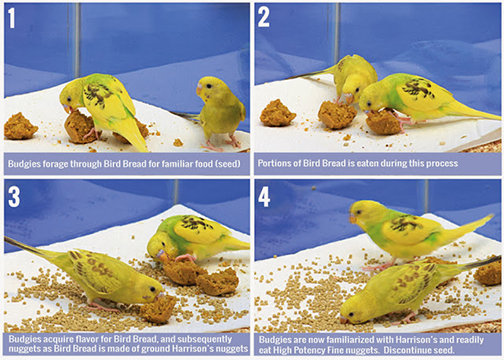
A very stubborn pair of budgies who were on a sole diet of spray millet were brought to us for a conversion trial. (Budgies are shown in this trial – but other small species including cockatiel, canary, lovebird etc. all typically convert similarly)
The pair was ravenous for spray millet but ignored any other foods offered.
At that point we baked a batch of Harrison’s Bird Bread in small muffin shapes with spray millet mixed into the bread. The bread was broken up into pieces and placed on top of a clean paper towel at the bottom of the cage.
As expected, for the first few days the pair sorted through the muffins for the millet. On day three however we observed that they were also now eating bits of the Bird Bread. The amount of millet mixed into the bread was reduced and eventually replaced with High Potency Fine. After a few more days the millet was completely removed and High Potency Fine was scattered amongst the pieces of Bird Bread on top of the white paper towel.
Within a few days not only were they off spray millet completely - they were now eating only Bird Bread and High Potency Fine
Though continuing Bird Bread as a treat is optional, after one more baked batch of Bird Bread was finished the diet was switched to High Potency Fine exclusively.
Document progress daily.
Never starve a bird.
IMPORTANT:
Diet Conversion is a Challenge not to be taken Lightly! It is imperative to immediately return a bird to its original diet if it refuses to eat the new diet.Small birds have a rapid metabolism and can starve to death in as little as 36-48 hours if they do not get enough food to eat. Owners should consult with an avian veterinarian and set up a conversion program that works but does not harm the bird in the process.
Modifying a bird’s diet is one of the biggest behavioral challenges an owner will undertake. Most issues can be overcome with patience and perseverance. Educating the owner about the benefits of feeding a formulated diet versus a seed-based diet is the first challenge.
Any dietary changes should be undertaken gradually. An important concern is the bird’s refusal to eat a “new” food, leading to significant weight loss. Weighing the bird (in grams) on a daily basis using a gram scale is the best method for monitoring adequate food consumption. Weight fluctuations greater than 10% are considered problematic. Even if provided with supplemental food, birds can starve to death while merely appearing to chew their food but not consuming it. Grinding the food into a fine powder is not the same as eating the food.
Monitoring droppings is an excellent indication of the amount of food the bird is eating. Prior to the diet change, the number and character of the droppings (color, amount, liquid, form, shape, lack of odor, staining) should be noted. Any change in the volume or number of droppings (usually a dramatic decrease in amount) indicates insufficient food consumption.
Owners should not be confused by the appearance of wet droppings, which they may assume to be normal. Wet droppings usually have little fecal matter produced from food consumption. Wet droppings are often a sign of weight loss as fat and muscle are converted to energy and water. The character of the droppings will change as the bird consumes more formulated diet – they usually become more firm with a definite shape.
Safely Taper The Diet
Note: All birds switching to Harrison’s should start out and remain on High Potency Coarse for a period of no less than 8 months. (Many species are recommended to stay on High Potency Coarse).
Any dietary changes should be undertaken gradually. An important concern is the bird’s refusal to eat a “new” food, leading to significant weight loss. Weighing the bird (in grams) on a daily basis using a gram scale is the best method for monitoring adequate food consumption. Weight fluctuations greater than 10% are considered problematic. Even if provided with supplemental food, birds can starve while merely appearing to chew their food but not consuming it. Grinding the food into a fine powder is not the same as eating the food.
Monitoring droppings is an excellent indication of the amount of food the bird is eating. Prior to the diet change, the number and character of the droppings (color, amount, liquid, form, shape, lack of odor, staining) should be noted. Any change in the volume or number of droppings (usually a dramatic decrease in amount) indicates insufficient food consumption. Owners should not be confused by the appearance of wet droppings, which they may assume to be normal. Wet droppings usually have little fecal matter produced from food consumption. Wet droppings are often a sign of weight loss as fat and muscle are converted to energy and water. The character of the droppings will change as the bird consumes more formulated diet – they usually become more firm with a definite shape.
Some birds switch to a new diet with little to no work on the owner’s part. Other birds are very selective about what they eat. Birds should not be left alone to select their own diets. Like human children, birds will often choose the wrong foods and “parental intervention” is required. The single most important thing you can do for your bird is to feed it right.
The”Controlled Meals” Diet Conversion Method (medium and large birds only)
Items required:
High Potency Coarse
- Make fresh Harrison’s nuggets available at all times throughout the day.
- Select ONE item that you know the bird is known to eat (in many birds this will be seed). Discontinue every other item from the bird’s old diet.
- Make that ONE item available three times a day, for a full 15 minutes (no shorter, no longer), then remove that food completely. Do not limit the amount of this food available during the 15 minute window (controlled meal). Space these feedings out by periods of 6 hours. Maintain a strict schedule.
- Offer no other food at any time.
- Taper. Once the bird is eating the nuggets remove one feeding window of the older food. The more the bird eats of Harrison’s remove a second window.
- Once the bird is switched completely to nuggets discontinue all feeding windows.
Birds are notorious tricksters. Confirm the bird is really eating by weighing the bird (daily) and observing frequency, volume and color of their stools. Stools should never be hard, dark or infrequent. Once fully converted, items like dark green veggies, sweet potato and carrot may be reintroduced. Feed Harrison’s at around 85% or more of the total diet with the remaining foods being the veggies mentioned above.
This method is best used in birds who’s eating habits can be individually observed. Split birds up into different enclosures or rooms during this period if necessary.
Never starve a bird.
AFRICAN GREYS
African
greys seem to be unique among parrots in their nutritional needs. The
two most commonly observed syndromes in this species are calcium
imbalance and respiratory disorders. New research sponsored by
Harrison’s indicates that African grey parrots must have direct daily
access to sunlight or UVB full spectrum lighting in order to obtain the
ideal levels of vitamin D3 and normal calcium levels in the blood. Diet
alone may not produce the ideal levels.
Although
African grey parrots may have a tendency toward atherosclerosis,
aggression and feather picking, feeding the High Potency Coarse
formulation exclusively, with no addition of seeds, nuts or table foods
to the diet, appears to minimize these negative characteristics. Birds
that are from parents selectively bred for their calm nature and are
parent-reared for several weeks before they are removed to be hand-fed
are the least likely to show these characteristics.
Geriatric
African greys may need some additional high quality fat in the diet.
One good source is organic Brazilian red palm oil, which is available in
Sunshine Factor as well as Harrison’s Power Treats.
Recommended Harrison's Formula for African Grey Chicks: Neonate Formula through Day 7, then Juvenile Hand-Feeding Formula for faster weight gain and reduced numbers of feedings daily.
Recommended Harrison's Formula for Adult African Greys: High Potency Coarse.
AMAZONS
Some
Amazons have a tendency to develop atherosclerosis and become obese as
they get older, which is suspected to be related to a metabolic
dysfunction involving glucose regulation, the thyroid gland, ovary or
liver. In contrast to what might be expected, these birds seem to
respond to the higher fat, higher protein formulation of High Potency
Coarse, as long as it is carefully measured by the piece to help
maintain their proper weight. Additional food items, such as sweet
potatoes, celery, bok choy and leafy greens may be added for bulk. Other
table foods, nuts or seeds are prohibited.
Amazon
parrots are best known for their excellent ability to mimic. Double
yellow-headed, yellow-naped and blue-fronted Amazons seem to have the
best potential for talking, laughing, coughing or even imitating a
baby's cry— perhaps males more than females. Other species may whistle
or scream. All Amazons tend to form a bond with a specific individual,
which may turn into aggression toward other family members, especially
during the breeding season.
Recommended Harrison's Formula for Amazon Chicks: Neonate Formula through Day 7, then Juvenile Hand-Feeding Formula for faster weight gain and reduced numbers of feedings daily.
Recommended Harrison's Formula for Adult Amazons: High Potency Coarse.
BUDGIES
Budgies
maintained on Harrison's experience longer, healthier lives, and their
former common health problems relating to the thyroid, kidney, fatty
tumors, obesity or reproduction are less evident.
Budgerigars
(commonly referred to as "parakeets" or "budgies") are quiet,
intelligent, nondestructive birds that are easy to care for. They are
the most popular and numerous companion birds because of their
relatively gentle, gregarious and entertaining personalities. They do
not tend to bond with an individual person, and frequently interact with
all family members. Budgerigars are capable of developing a large
vocabulary (perhaps 200-300 words) but some effort must be made to
accomplish this, and their voice is not as clear as other pet bird
species. Some individuals are also good at whistling. Not talking at all
is not unusual.
Recommended Harrison's Formula for Budgie Chicks: Neonate Formula through Day 7, then Juvenile Hand-Feeding Formula for faster weight gain and reduced number of feedings.
Recommended Harrison's Formula for Adult Budgies: High Potency Fine or Super Fine for a period of no less than 8 months, Adult Lifetime Fine or Super Fine optionally thereafter.
CANARIES and FINCHES
Canaries
and finches from a pet store often have a relatively short life
compared to other species, but when fed Harrison's, they are robustly
healthy and longer-lived.
Canaries are tidy,
nondestructive and easy to care for, but they do not like to be handled.
They are appreciated most for their pleasant, melodious song. All male
canaries sing, starting as early as three months of age. If a male
canary becomes ill, it may stop singing until the following spring even
though the initial illness has resolved. Canaries are not social birds.
One bird kept as a single pet will be content.
Recommended Harrison's Formula for Adult Canaries and Finches: High Potency Fine or Super Fine for a period of no less than 8 months,
Adult Lifetime Fine or Super Fine optionally thereafter.
Visit www.harrisonsbirdfoods.com/canaries.html for canary breeder egg-food recommendations
COCKATIELS
White
cockatiels with lutino ancestry have a reddish-colored iris and a
tendency toward yellow in the normally white feathers. These birds are
prone to liver and kidney disorders. Long-term administration of herbs,
such as lactulose and milk thistle, has been beneficial in controlling
the liver disorder. Adding a teaspoon of flax seed or spray millet to
the diet seems to help the kidneys if the birds are fed a formulated
diet. These birds require close supervision by an avian veterinarian.
White cockatiels with pied ancestry (dark-colored iris and pure white
feathers) seem to be stronger in both these aspects.
Other
common cockatiel problems of obesity, fatty tumors, xanthomas, and
reproductive and feather disorders are significantly reduced when
cockatiels are fed Harrison's.
Cockatiels are
relatively quiet, nondestructive, entertaining birds that are easy to
care for. Because they are considered so gentle, they are excellent as
companion birds for children. Cockatiels are limited talkers, but some
individuals are so good at whistling that their tunes are recognizable.
Recommended Harrison's Formula for Cockatiel Chicks: Neonate Formula through Day 21, then Juvenile Hand-Feeding Formula for faster weight gain and reduced number of feedings..
Recommended Harrison's Formula for Adult Cockatiels: High Potency Fine for a period of no less than 8 months, Adult Lifetime Fine optionally thereafter.
COCKATOOS
Behaviorally,
cockatoos have a tendency toward aggression and feather picking;
however, these characteristics can be reduced by several factors:
feeding Harrison's exclusively without the addition of seeds, nuts and
table foods, choosing parents that are selectively bred for their calm
nature, and parent-raising the chicks.
Large cockatoo
species (e.g., umbrella, Moluccan, sulphur-crested) need extra high
quality fat in the diet occasionally (Certified organic red palm oil -
available in Power Treats and AVIx Sunshine Factor).
Cockatoos
are appreciated as companion birds because they enjoy "cuddling."
Cockatoos are like small children - they can be charming and may try to
"steal the show." Care must be taken to avoid spoiling these birds.
Cockatoos have some capacity to mimic but their voice is not as clear as
other parrots.
Recommended Harrison's Formula for Cockatoo Chicks: Neonate Formula through Day7, then Juvenile Hand-Feeding Formula for faster weight gain and reduced numbers of feedings daily.
Recommended Harrison's Formula for Adult Cockatoos:
High Potency Coarse.
LORIES
There are many "lory diets" or nectars on the market that are not safe to feed long term. Many are too high in vitamin A (often containing toxic levels) and are deficient in many other nutrients needed by lories.
The primary disorders traditionally seen in lories, including obesity, liver malfunction, fatty tumors, bone disorders, respiratory diseases, and fungal and yeast infection, are significantly reduced when the birds are fed Harrison's. In addition, the low levels of iron in Harrison's formulations reduce the risk of iron storage disease, to which lories are particularly prone.
Lories are brilliantly colored, playful birds with extroverted personalities and entertaining antics. Due to their curious nature, these birds are often subject to traumatic injuries in captivity. Although they have limited talking ability, they can be noisy, making a variety of high-pitched sounds.
Recommended Harrison's Formula for Lory Chicks: Neonate Formula through Day 7 then Juvenile Hand-Feeding Formula for faster weight gain and reduced numbers of feedings daily.
Recommended Harrison's Formula for Adult Lories: High Potency Fine for a period of no less than 8 months,
Adult Lifetime Fine optionally thereafter. Soak the formula in 2 Tbs water and ½ tsp glucose or fruit juice.
MACAWS
Macaws fed Harrison's are usually problem free, living a maximum life expectancy. Commonly reported problems in the veterinary literature, such as reproductive and feather problems in adults or digestive disorders, bacterial, fungal, bone and beak problems in babies, are usually not seen in macaws fed Harrison's.
Some of the larger species like Hyacinths may need extra oils, as derived from two large walnuts or a dose of Sunshine Factor daily.
Macaws require a great deal of attention and living space. Blue and gold macaws have a mischievous nature and are the most family-oriented macaw species, even though they may be nervous around strangers. Although scarlet macaws tend to bond with an individual person, they can be nippy with anyone. Green-winged macaws are less intimidating and calmer but can be very loud. Macaws have limited ability to mimic words. Their vocalizations are expressed primarily as loud shrieks and squawks, especially in the early morning and late afternoon.
Recommended Harrison's Formula for Macaw Chicks: Neonate Formula through Day 7 then Juvenile Hand-Feeding Formula for faster weight gain and reduced numbers of feedings daily.
Recommended Harrison's Formula for Adult Macaws: High Potency Coarse.